The £5,000 Plastic Cone: The Dark Art of Traffic Management
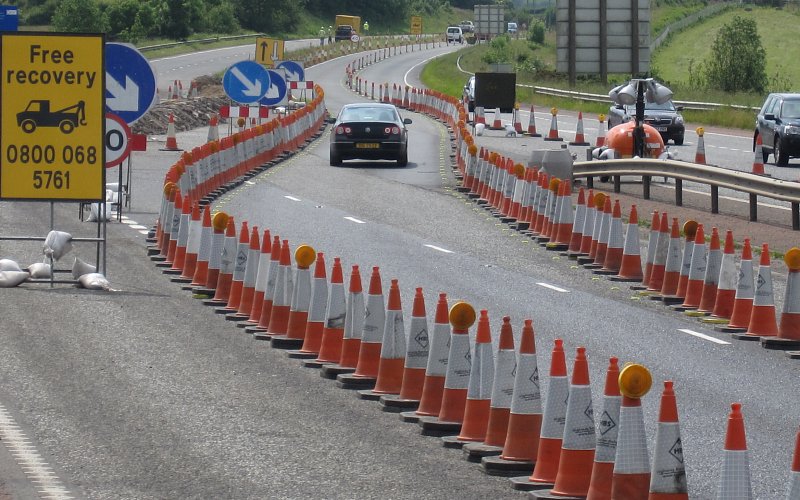
To the general public, a traffic cone is a £10 piece of fluorescent plastic. It is a minor inconvenience on the morning commute. To a university student, it is a decorative hat to be placed on a municipal statue at 3:00 AM.
But if you are a Site Engineer or a Project Manager on a major UK highway upgrade, you know the terrifying truth. That piece of plastic is not cheap. It is the single most expensive, highly regulated, and heavily weaponised piece of equipment on your entire site.
Welcome to the dark, incredibly stressful art of Traffic Management (TM). It is a world where placing a piece of plastic three inches over a white line can result in an international phone number-sized fine, and where the laws of physics are fought daily by a bloke in a high-vis jacket eating Monster Munch in a transit van.
The Bible of the Road: Chapter 8
If you want to close a lane on the M1 to dig a trench, you cannot just park your Hilux across the white line and put your hazard lights on. You must comply with the "Traffic Signs Manual: Chapter 8."
Chapter 8 is the undisputed, tyrannical bible of UK roadworks. It dictates the exact millimeter spacing of every cone, the reflectivity of every sign, and the precise angle of the approach.
The most critical educational concept in this manual is the Taper.
The taper is the diagonal line of cones that forces 44-tonne HGVs out of the lane you want to work in. You do not just guess this angle. It is a mathematical calculation based on the Stopping Sight Distance (SSD) and the speed limit of the road. On a 70mph motorway, you are legally required to provide a massive, sweeping funnel of warning signs miles in advance, culminating in a gentle, highly specific geometric taper.
If your taper is too short, lorry drivers don't have time to react, and they simply plough straight through the plastic and into your excavation. If your taper is too long, you are unnecessarily restricting traffic flow, and National Highways will send you a passive-aggressive email that ends up costing your company £50,000.
The Kinetic Sponge: The IPV
Because cones are just plastic, they do not actually stop vehicles. They are just polite suggestions. And at 2:00 AM, a tired HGV driver drifting out of their lane will not be stopped by a polite suggestion.
This brings us to the unsung hero of civil engineering: the Impact Protection Vehicle (IPV), commonly known as the Crash Cushion.
An IPV is essentially an 18-tonne lorry parked at the start of your worksite with a massive, yellow, collapsible aluminium honeycomb bolted to the back of it. Its entire structural purpose in life is to be violently destroyed.
When a sleeping driver hits your road closure at 60mph, the IPV's crash cushion absorbs the massive kinetic energy transfer, crumpling inwards in a controlled deceleration. It sacrifices its own chassis to save the lives of the drainage gang working in the trench fifty metres ahead. The IPV driver - who is paid to sit in the cab of this vehicular target practice all night - is arguably possessing nerves of steel unmatched anywhere else in the industry.
The £5,000 Cone and Lane Rental
So, why do we call it a £5,000 cone? Because of "Lane Rental" and hand-back fines.
When you close a lane on a strategic road network, you are essentially renting that asphalt from the government. The deal is absolute: you must pick up your cones and hand the carriageway back to the public by exactly 6:00 AM.
At 5:30 AM, a unique, primal panic sets in across the site. The concrete hasn't cured. The excavator is stuck in the mud. But the TM Foreman (usually a man named Keith) is standing on the verge, tapping his watch.
Keith does not care about your concrete. Keith cares that if he leaves one single cone protruding into the live lane at 6:01 AM, the "Overrun Charge" kicks in. These fines are designed to be utterly punitive, sometimes charging the contractor upwards of £5,000 for every *fifteen minutes* the road is handed back late.
The TM Brotherhood
Traffic Management gangs are a fascinating sociological subculture. During the shift, they sit in the cabs of their idling vans with the heaters on full blast, listening to local radio and radiating an aura of complete boredom.
But watch them when the road closure goes on. They step out onto a live motorway carriageway in the dark, physically dropping cones onto the tarmac while lorries fly past their shoulders at 70 miles per hour, missing them by inches. They operate with a casual, terrifying bravery that graduate engineers can only marvel at from the safe side of the barrier.
We spend years at university learning how to design bridges and calculate fluid dynamics. But never forget that we only get to build those things because Keith bravely stepped out into the fast lane on a rainy Tuesday night to put a plastic hat on the road.
Mosbah