The Jagdeeps of the World.
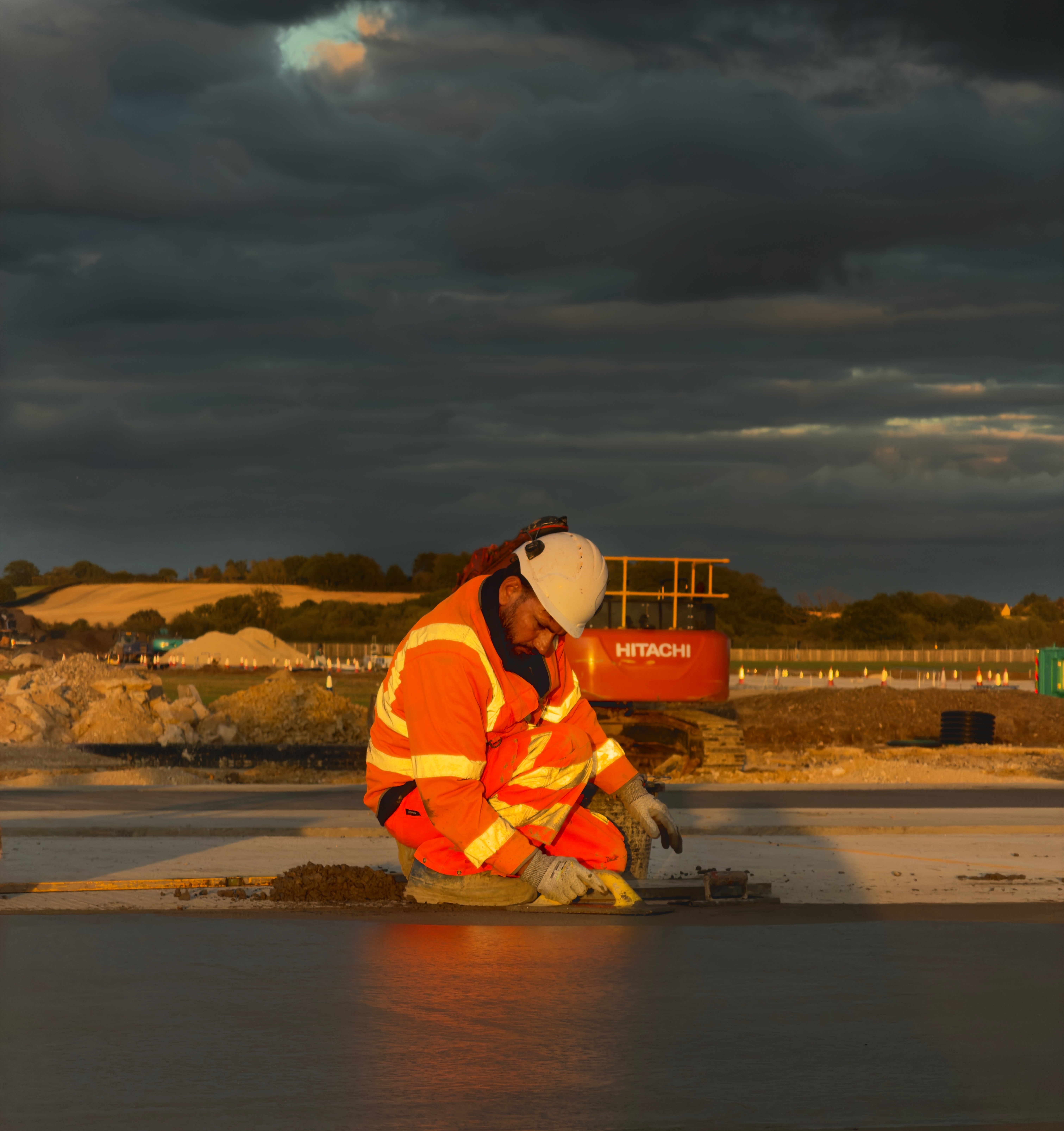
It had been one of those Fridays where the site actively conspires against you.
The 360 went down before nine. Two subcontractors arrived wanting the same twenty metres of haul road at the same time, both waving a programme that said they were right. And then at half four, when every sane person in the UK was thinking about a takeaway, I found that we'd miss a week of as-built data.
So I did what every engineer does. I sat in a heated cabin and felt sorry for myself.
Picture the desk I was doing it at. Scratched laminate under a tangle of charging cables. Three A1 drawings curled at the corners. Four coffee rings, a dried-out marker, half a packet of biscuits, a spirit level with the bubble gone. Absolute chaos, all of it mine.
By eight the site was dead. Gates shut, office lights flickering off, nobody left to want anything from me. I shut the laptop, picked up my keys and stepped out into what was left of the light.
And he was still there.
Alone on the slab, kneeling, finishing the pour.
It was quiet enough that the only sound in the world was the trowel. Steel on wet cement, back and forth, back and forth. The sound of a man who has made that exact motion ten thousand times.
I stood in the doorway and watched him for a while.
Then I lifted the camera and took the photograph at the top of this page.
Then I got in the car and drove home.
That's the whole story. There is no heartwarming section where I walk over. I didn't speak to him. I photographed him, which is a considerably easier thing to do to a person.
I drove the hour back in silence, and by the time I reached the hotel I had four things straight that I'd had wrong for about five years.
One: There Is No Such Thing As An Unskilled Worker
Concrete does not care about your shift pattern. Once the slab is placed you get one window to finish it, and the window opens and closes on the concrete's terms.
The bleed water has to rise and clear first. Start floating while it's still sitting there and you work that water back into the surface and you've just made a top that will separate and fail, not next month but for the life of the slab. So you wait.
Then it stiffens and the whole thing reverses. Now it's running away from you. Float, then trowel, pass after pass, each one needing more pressure than the last as it goes off beneath you. Edges by hand, corners by hand, anywhere the machine can't reach by hand. Kneeling boards, because your own weight would mark the surface you've spent four hours perfecting.
And you can't stop. Miss the window and it isn't a snag on a list. It's a break-out and a re-pour.
That's why a man is on his knees at eight o'clock on a Friday night in September. Not because anybody told him to stay, but because the pour started when it started, the cold dragged the set out, and the slab decides when the job is done.
I have stood over a great many pours. I have signed off a great many slabs. I could not finish one.
I know the theory perfectly; the timings, the tolerances, the clause it breaches when it goes wrong. He knows it in his hands, in the dark, tired, alone, at the end of a long week. Those are not the same knowledge, and mine is not the higher one.
So "unskilled" isn't a description of that man. It's a pricing decision. We invented the word so we could treat a trade that takes a decade to learn as though anyone off a van could do it, and then we're surprised when the finish comes back wrong and the rework eats the margin.
Two: Being Moved By Someone Is Not The Same As Knowing Them
His name is Jagdeep. He's on the concrete gang, and he's better at his trade than I am at mine. That is very nearly all I have.
Here's a confession, because I nearly did something worse than walking past him.
The first draft of this post had three more paragraphs here. Good ones. The room he sleeps in and the men in it. His children on a cracked phone screen from a cold welfare cabin. The cement dust in his hands. The money going home every month, and the weight of all of it.
It was genuinely moving. And I invented every word.
Reading it back, I saw what I'd done. The industry flattens him into "unskilled labourer." I was about to flatten him into something nobler and equally invented; a dignified man in the mud, quietly teaching the engineer a lesson about gratitude. Different label, better manners, same act. And mine had the advantage of making the author look kind.
Writing movingly about a man you've never spoken to isn't empathy. It's the feeling of empathy, which is a good deal more comfortable, because the real thing means standing in the cold asking questions and finding out you were wrong. If you're deeply moved by someone whose surname you don't know, the honest response isn't a post. It's a conversation.
Three: We Take Most From The Ones Who Ask For Least
This part I can say with confidence, because I've watched it happen on every job I've been on.
The men who never complain get more work, not less. Compliance is the cheapest thing on a construction site, and nobody ever has to argue for it, so it's spent first and spent hardest. It isn't cruelty. Nobody sits down and decides it. It's just that pressure runs downhill and settles wherever it meets no resistance, and there's always one man who offers none.
If you run people, the practical version is simple. The man you never hear from is the one to go and find. Not the one making noise, the noisy one is negotiating, and he'll be fine. It's the quiet one absorbing the difference, and the system will keep taking precisely because he lets it.
Four: You Will Not Notice The Day You Change
I used to know these men.
When I started on site I knew the groundworkers' kids' names. I knew who was getting married, whose knee was gone, which of them supported which hopeless football team. I stopped, I asked, I listened to the answer. That isn't a virtue I'm claiming. It's just what you do at twenty-three, before anyone's told you your time is supposed to be precious.
Somewhere across five years, it went.
I can't point at the week. There was no meeting where I decided to be less interested in people. I keep my head down now. I protect my programme. I've walked past that man, and forty like him, more times than I could count; and the part that stayed with me on the drive home is that it doesn't feel like anything. There's no guilt at the time. There's nothing at the time. That's what erosion is: not a decision you regret, but a capacity you stop noticing you had.
I liked that twenty-three-year-old. He was worse at the job and better at the rest of it.
There's a line in Taxi Driver: within six months, I thought like a taxi driver, I behaved like a taxi driver, I spoke like a taxi driver. That's the real hazard of this work, and it has nothing to do with hours or weather or knees. The site is a living thing with its own manners and its own opinion of who matters, and it will assimilate you slowly enough that you never feel it happening.
So here's a test, since none of this is visible from the inside. Name three people on your site who don't work for your company. First names will do.
I failed my own test in a doorway at eight o'clock on a Friday.
I can't get the five years back, and I'm not going to pretend on a blog that one photograph has made me a better man. That isn't how any of it works.
What's in front of me is much smaller than that. Stop using the word unskilled. Ask before being moved. Go and find the quiet one. And take the test again in a few months, because it won't announce itself.
And then the thing I didn't do on Friday: walk the thirty metres, ask him a question, and find out how much of what I assumed was wrong.
I'm back on that site Monday, and I'll carry two teas out with me.
One sugar, no milk. That's how I take mine. I've no idea how he takes his, which is rather the point.
Mosbah