The Scaffolding Tag Illusion: The Dark Art of Temporary Works
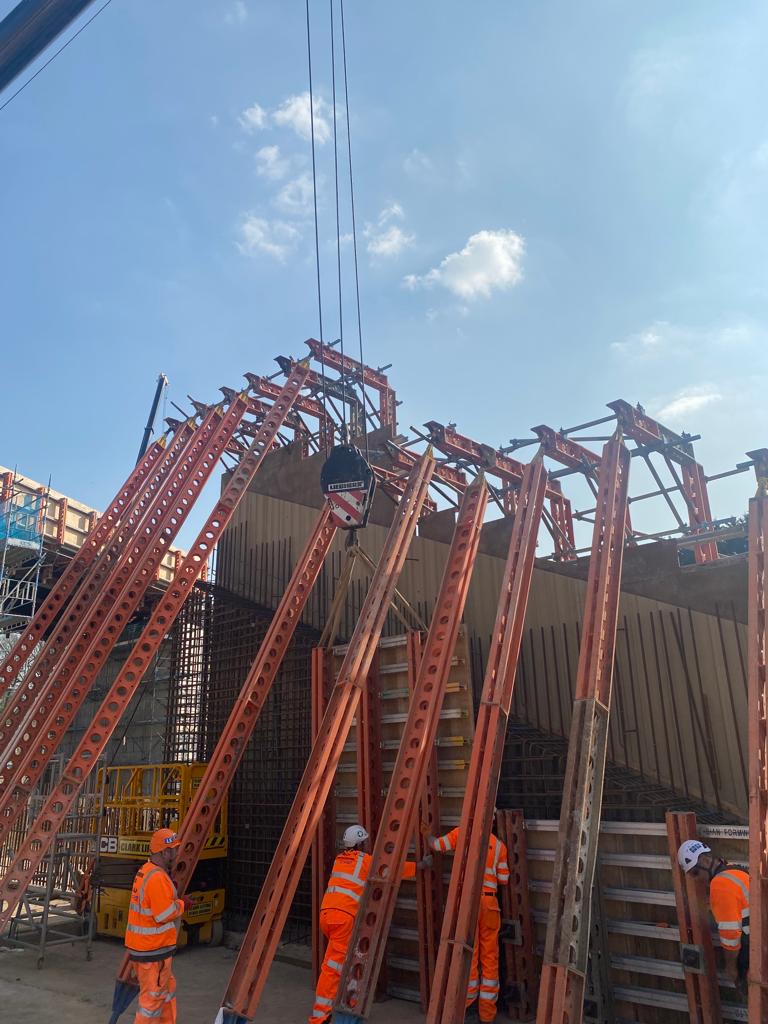
Walk onto any £100 million infrastructure megaproject, and you will see incredible feats of modern engineering. You will see 50-tonne precast concrete beams suspended mid-air. You will see deep, subterranean tunnel shafts holding back thousands of tonnes of groundwater. You will see sweeping architectural curves that took a team of PhD structural engineers three years to model in a climate-controlled office.
And holding all of this up - the sole mechanism preventing this multi-million-pound masterpiece from violently collapsing into a pile of rubble - is a collection of rented rusty steel tubes, a few battered Acrow props, some timber wedges, and a green plastic tag secured with a zip-tie.
Welcome to the terrifying, high-stakes world of Temporary Works.
In the UK, it is the dark art of civil engineering. It is a discipline where you are legally required to suspend the laws of gravity using materials that look like they were salvaged from a scrap yard, all while adhering to a legal framework plucked right from the Middle Ages.
Let’s start with the psychological phenomenon of the "Scafftag" (or the Temporary Works Permit to Load).
To the untrained eye, a massive scaffold tower or a heavy-duty falsework arrangement is a terrifying, precarious structure. But to a site engineer, its structural integrity is dictated entirely by a 4-inch piece of plastic.
If the plastic tag is red (or missing), the structure is legally considered a lethal weapon. If you step on it, it will instantly vaporise you. However, the moment the Temporary Works Coordinator (TWC) scribbles their initials on the green insert and slides it into the holder, the structure undergoes a magical, metaphysical transformation. It is now structurally invincible. You could park a Challenger tank on it, and a Boeing 747 for good measure.
This is the Scaffolding Tag Illusion. We place absolute, blind faith in the administrative process of temporary works, often forgetting the brutal physics underpinning it.
4D Engineering: Temporary vs. Permanent Load Paths
Why are temporary works so much more dangerous than permanent works? It comes down to the physics of load paths and time.
When a design consultancy designs a permanent viaduct pier, the load path is static. Gravity pulls down, the pier transfers the load to the pile cap, the pile cap transfers it to the piles, and the piles transfer it to the bedrock. It is a 3D problem, and once it is built, it stays that way for 120 years.
Temporary works, however, are a 4D problem. The load paths are constantly, violently changing.
Take a massive concrete wall pour. At 8:00 AM, the temporary formwork is holding nothing but its own self-weight. By 11:00 AM, you are pumping liquid concrete into it. The formwork is suddenly subjected to massive hydrostatic pressure pushing outwards. If the pour rate is too fast, the formwork blows out, and you have £50,000 of wet concrete flooding the site. (TW drawings often have their allowable maximum rate of rise; measured in meters per hour)
By 3:00 PM, the concrete starts to cure and heat up (exothermic reaction), changing the pressure dynamics again. Two days later, you strike the formwork. Suddenly, the load path shifts from the temporary steel back to the permanent concrete.
If you get the math wrong at any single point in that 48-hour timeline, someone dies.
BS 5975 and the Most Stressed Person on Site
Because temporary works are so inherently dynamic and dangerous, the UK industry introduced BS 5975 - the code of practice for temporary works procedures. And with it came the creation of the most stressed, legally vulnerable person on any construction site: The Temporary Works Coordinator (TWC).
The TWC is the gatekeeper of gravity. They are the person who has to look a screaming Project Manager in the eye and say, "No, you cannot pour that concrete today, because the ground bearing capacity for the crane outriggers is 50kN/m2 short."
The TWC lives in a constant state of paranoia because they know the golden rule of site execution: Site gangs love to improvise.
A temporary works designer will spend three days calculating the exact bracing required for a deep excavation trench box. They will issue a beautiful, stamped drawing. But when the groundworkers get into the trench and realise the steel cross-strut is slightly in the way of their excavator bucket, they will simply remove it with a sledgehammer, entirely ignorant of the fact that they just compromised a 500-tonne active soil pressure load path.
The TWC is the only person standing between that sledgehammer and a catastrophic failure.
The "Standard Solution" Trap
The greatest threat to temporary works isn't extreme weather or earthquakes; it is complacency.
Because we erect temporary works every single day, we fall into the trap of "Standard Solutions." We assume that because a 3-meter hoarding fence stood up on the last project, we can just build exactly the same fence on this project.
But temporary works do not exist in a vacuum. On the last project, the fence was shielded by a building. On this project, it is sitting on the edge of an embankment, acting as a massive 30-meter-long sail catching a Category 8 gale off the Cornish coast. The wind loading (with a formula too difficult for me to even begin comprehending) increases exponentially. When the fence inevitably blows over onto a public footpath, the HSE inspector isn't going to care that it was a "standard solution." They are going to ask for the bespoke wind calculations.
Conclusion
The next time you are on site, take a moment to look away from the gleaming permanent structure and look at the ugly, battered, rented steel holding it up.
Permanent works are designed by teams of PhDs with years of time, infinite budgets, and advanced software. Temporary works are often designed in a few days, built in the mud, and rely entirely on the ruthless discipline of the site team to ensure the math translates to reality.
Respect the Scafftag. Respect the TWC. And whatever you do, don't touch that timber wedge.
Mosbah