The "As-Built" Fiction: The Greatest Creative Writing Exercise in Engineering
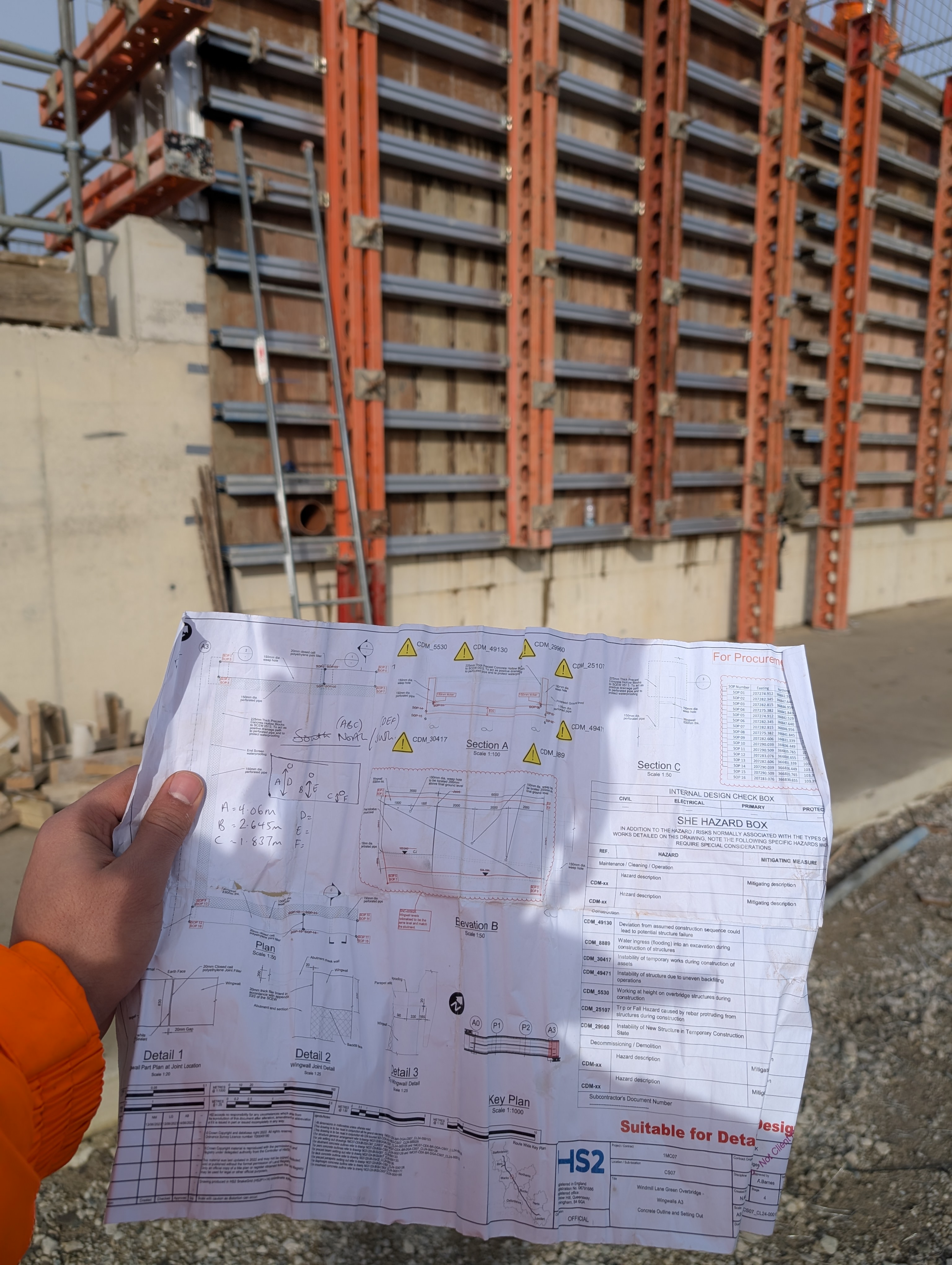
There are many established genres of literature in the world: Science Fiction, Historical Romance, True Crime. But if you walk into the site office of a major infrastructure project during its final two weeks, you will witness the creation of an entirely different genre.
It is a genre characterised by imagination, optimism, and frantic guesswork. It is called the As-Built Drawing.
To the uninitiated Client, an "As-Built" (or Record Drawing) is a precise, legally binding geometric map of exactly what has been constructed. To the Site Engineer who has been tasked with producing it at 4:30 PM on a Friday to secure the release of the project's retention money, it is an exercise in creative writing.
We boast about "Digital Twins" and millimeter-perfect 3D models, but the dirty secret of the construction industry is that our historical record-keeping often relies on a sleep-deprived engineer, a lukewarm coffee, and a thick red Sharpie.
The Red-Line Ritual
The creation of the As-Built usually begins when the Commercial Manager realises the Client will not pay the final bill until the Health & Safety File and O&M (Operations & Maintenance) manuals are handed over.
Panic ensues. A graduate engineer is handed a pristine set of the original "Issued for Construction" (IFC) drawings and told to "mark up the changes."
This initiates the Red-Line Ritual. The engineer sits down and tries to cast their mind back six months to a rainy Tuesday in November.
"Did we lay that 11kV high-voltage cable exactly 1.2 meters from the kerb line? Well, there was that massive unmapped concrete block in the way, so we diverted around it. How far? Maybe a meter to the left? Yeah, let's draw a red squiggle a meter to the left."
Within hours, the drawing looks like a child’s colouring book. Drainage runs that were supposed to be straight now feature mysterious dog-legs. Sub-base depths are averaged out. Manhole invert levels are "interpolated" (which is the mathematical term for guessing).
The drawing is then scanned, stamped "AS-BUILT," and handed to the Client. The fiction is complete.
The Physics of Geometric Drift
But why do we have to guess in the first place? Why isn't the As-Built just a carbon copy of the design?
Because of 'Geometric Drift'. The physical world is messy, and paper is flat.
During execution, a project is subject to thousands of micro-deviations. You might hit an unmapped Victorian sewer while excavating for a viaduct pile cap. To avoid a £500,000 delay, you instruct the piling rig to shift 300mm to the right. The pile cap moves. The pier moves. The bearings move.
Furthermore, there is the accumulation of allowable tolerances. If a structural steel specification allows a +5mm tolerance on every connection, and you bolt twenty beams together, you could be 100mm off your theoretical gridline by the end of the span.
In the heat of battle, these changes are engineered safely and correctly on the fly. But because site teams are drowning in NEC4 paperwork, RFIs, and lifting plans, these physical deviations rarely make it back into the master CAD file in real-time. The "Golden Thread" of information snaps.
The "Digital Distant Cousin"
This brings us to the great modern buzzword: The Digital Twin.
Clients love mandating BIM Level 2/3 Digital Twins. They want a beautiful, navigable 3D Revit model of their new highway or rail tunnel.
But unless you are using continuous laser point-cloud scanning and drone photogrammetry *during* the backfill process, you are not handing over a Digital Twin. You are handing over a Digital Distant Cousin. You are giving the Client a beautiful 3D model of what the designer wished had happened, occasionally updated with the red-marker guesses of a stressed site engineer. As long as they are happy right?
When you bury a 10-tonne concrete thrust block over a pressurised water main, that data is lost forever the moment the excavator covers it in topsoil. If the surveyor didn't shoot it with a GPS rover before the dirt went in, it practically doesn't exist.
The Real-World Consequence: The Next Guy
It is easy to laugh at the absurdity of the Red-Line Ritual, but the consequences of the As-Built Fiction are deadly serious.
Ten, twenty, or fifty years from now, another engineer is going to stand in that exact spot. They are going to be tasked with widening the highway or sinking a new pile. They are going to look at your beautifully stamped As-Built drawing, which confidently states that the 11kV high-voltage cable is exactly 1.2 meters away from their excavator bucket.
They are going to trust your fiction. And when the steel teeth of that bucket bite into the earth, the difference between the red line you drew and the physical reality you forgot could cost them their life.
Conclusion
The construction industry is obsessed with the speed of the build, but we treat the legacy of our data as an administrative afterthought.
If we want to stop building £60 billion megaprojects on a foundation of guesswork, we have to treat spatial data capture as a critical path activity, not a Friday afternoon chore.
Because an engineer’s job isn't just to build the infrastructure for today; it is to leave an honest map for the poor soul who has to dig it up tomorrow.
Mosbah