The Millimetre Delusion: Why Your £40,000 Leica is Lying to You
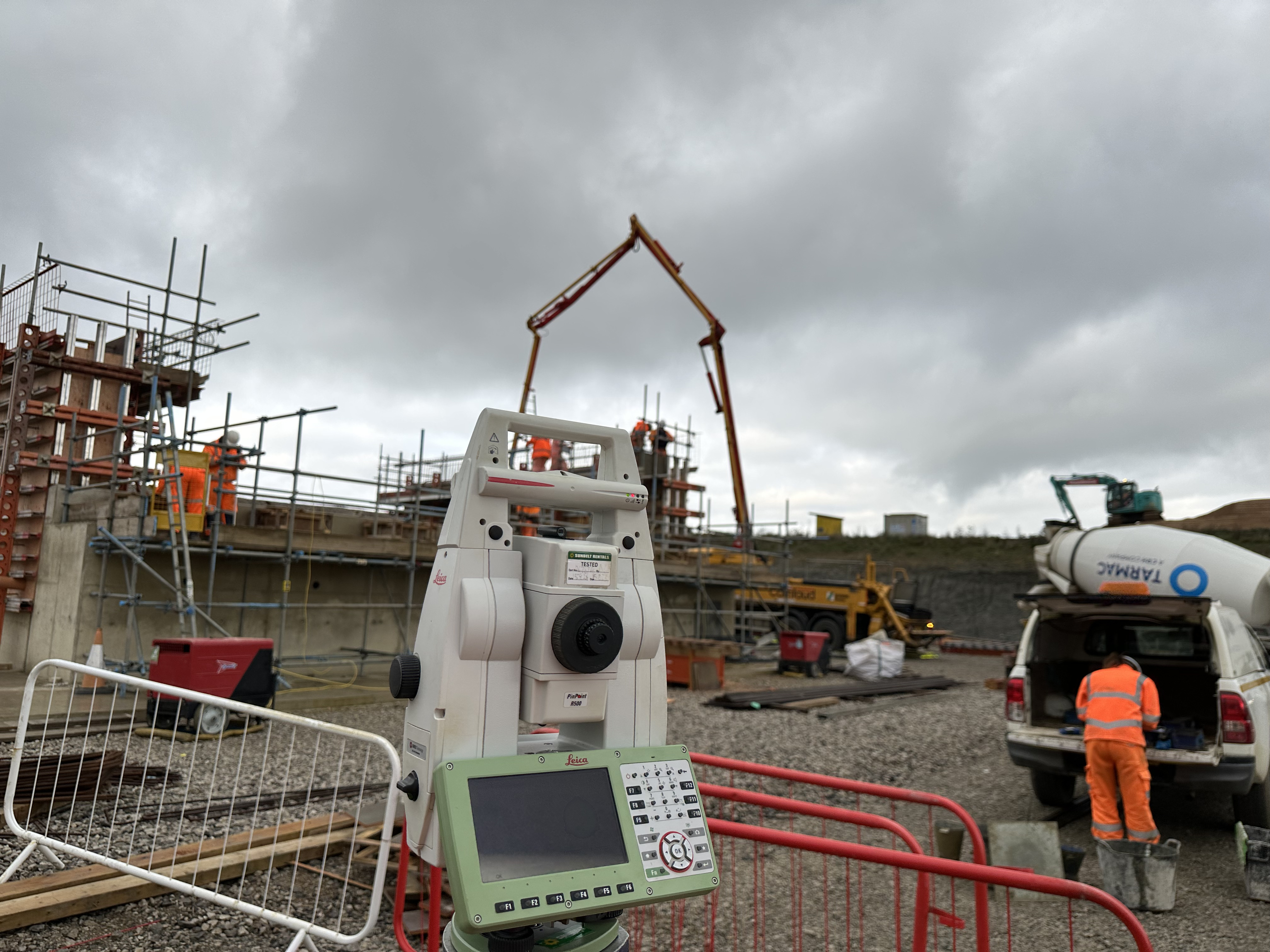
Walk onto any major infrastructure project in the UK on a freezing Tuesday morning, and you will inevitably witness a very specific, deeply tragic ritual.
Somewhere in the distance, standing in shin-deep clay, is a 22-year-old graduate Site Engineer. They are wearing a spotless high-vis jacket, clutching a carbon-fibre detail pole, and staring intensely at the screen of a £40,000 robotic Leica Total Station. They are aggressively tapping a wooden peg into the mud, checking the screen, sighing, and tapping it again. They will spend ten minutes trying to get the residual error down from 0.003 metres to 0.001 metres.
They believe they are performing elite-level precision engineering. What they are actually doing is participating in the greatest delusion in modern construction.
Because sitting directly behind them, idling in a cloud of diesel smoke, is a 30-tonne Komatsu excavator. It is operated by a man named Nige, who is currently eating a Bacon Frazzle and operating a steel bucket the exact size of a Ford Transit van. Nige does not care about your millimetre. Nige could not physically dig to a millimetre if his life depended on it.
Welcome to the Millimetre Delusion. It is the fundamental disconnect between digital capability and mechanical reality, and it costs the industry thousands of wasted hours every single week.
The problem starts at university. We are taught that precision is the ultimate goal of the engineer. We are handed CAD software that allows us to zoom in to ten decimal places. So, when a young engineer steps onto site with an instrument capable of measuring the wingspan of a gnat from two miles away, they naturally assume they must use that capability for everything.
But the Total Station is lying to you. Or rather, it is telling you a highly conditional truth.
Yes, the laser has measured the distance to the prism to the nearest millimetre. But what the screen doesn't tell you is that your wooden tripod is currently sinking into the wet topsoil by 3mm. It doesn't tell you that the 15-degree temperature swing since breakfast has caused the instrument’s calibration to drift. It certainly doesn't tell you that the wooden peg you just hammered in is going to be accidentally run over by a dumper truck in fourteen minutes anyway.
The hardest lesson a Site Engineer must learn is not how to operate the equipment, but how to apply context to the numbers. You have to understand what you are actually building.
- The Muck Shift (Tolerance: Close Your Eyes and Guess): If you are setting out batter profiles for a highway embankment or a balancing pond, you are dealing in bulk earthworks. Earth moves. It swells, it shrinks, and it washes away. If you spend twenty minutes trying to stake an earthworks profile to the nearest millimetre, you are fundamentally misunderstanding soil mechanics. Give Nige a peg, spray it with neon pink paint, get it within +/- 20mm, and get out of the way so the machines can work.
- The Concrete Pour (Tolerance: The Width of a Pencil): If you are setting out formwork for a concrete slab or a bridge abutment, things tighten up. Now you are dealing with +/- 5mm to 10mm. But even here, reality intervenes. You can set the shuttering perfectly to the millimetre, but the moment you drop 40 tonnes of wet, vibrating concrete into it, that timber is going to flex. The millimetre you chased all morning disappears the moment the concrete pump starts.
- Holding Down Bolts (Tolerance: Absolute Paranoia): This is where you actually earn your salary. If you are setting out Holding Down (HD) bolts for a 500-tonne structural steel frame, the millimetre is suddenly the most important thing in the world. If those bolts are out by 5mm, the steel columns won't drop over the threads. You will have a gang of furious steel erectors, a £7,000-a-day mobile crane sitting idle, and a Project Manager asking you to politely explain yourself. For HD bolts, you use a mini-prism, you set up on concrete, and you chase that 0.001m like your career depends on it - because it does.
The Cure for the Delusion
To be a brilliant Site Engineer, you must stop being a slave to the digital readout. The Leica is a tool, not a religion.
The next time you are setting out, take your eyes off the screen for ten seconds. Look at the mud. Look at the size of the aggregate in the concrete. Look at the mechanical violence of the machinery surrounding you. Ask yourself: What is the physical reality of the material I am trying to control?
If you are building a Swiss watch, chase the millimetre. If you are digging a hole in Leicestershire in the pouring rain, put the spray paint on the ground, give Nige a thumbs-up, and go and get a cup of tea.
Mosbah