The Screen vs. The Mud: The Hidden Danger of 3D Machine Control
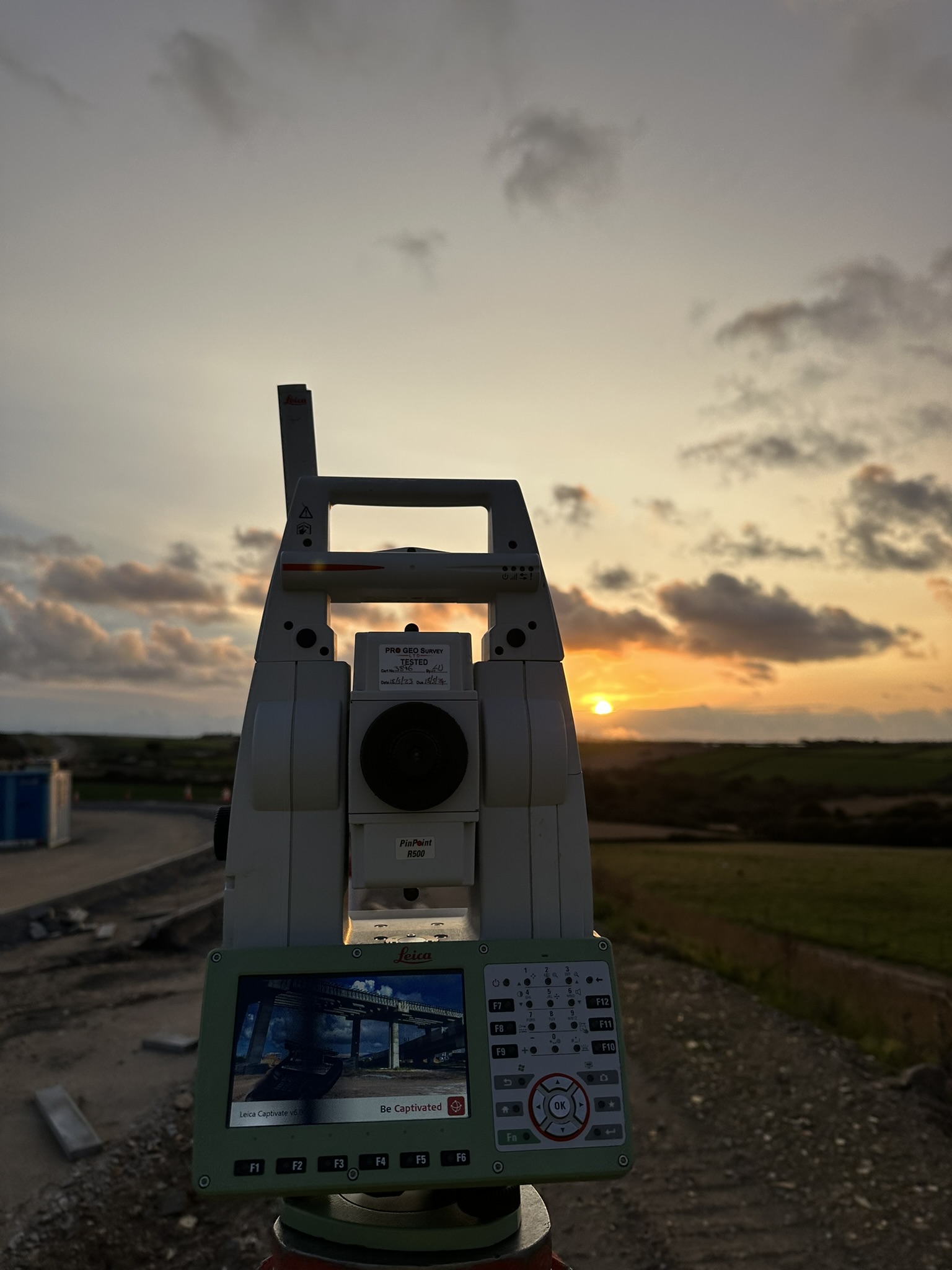
If you walk onto a major earthworks or highway infrastructure project today, you will notice something missing: timber.
Ten years ago, a highway site was a forest of batter rails, profile boards, and string lines. Today, you look out over a 12-mile stretch of the A30 and see nothing but pristine, profiled sub-base. Inside the cab of the excavator, the operator is watching a 3D model on a Leica or Trimble screen, digging to a digitized surface with millimeter-perfect accuracy.
The integration of 3D Machine Control and GPS/UTS (Universal Total Station) systems has completely revolutionised civil execution. We are slipforming miles of concrete step barriers and cutting sub-base levels to <5mm tolerances faster than ever before.
But as an engineer who has managed these systems across high-speed rail tunnels and major highway upgrades, I have noticed a deeply concerning trend. We are breeding a generation of site engineers and operators who blindly trust the screen, entirely abandoning their physical spatial awareness.
We have replaced human error with something much more dangerous: automated, high-precision mistakes.
The Epidemic of "Blind Trust"
In the past, setting out a complex drainage run or a surface water channel was an intensely physical and mathematical process. You had to calculate falls, physically hammer pegs into the ground, write the cut/fill on the stake, and visually check the line with your own eyes. If something looked wrong - if the water wouldn't flow - you stopped and checked the drawings.
Today, the workflow often looks like this: The design team emails a CAD file. The site engineer converts it to an '.xml' surface file, loads it onto a USB, plugs it into the excavator’s control panel, and walks away.
The machine does exactly what it is told. But what happens when the data is wrong?
Garbage In, Precision Out
Machine control does not possess engineering judgment; it only possesses execution capability. It will happily and perfectly construct a disastrous error.
During my time on the A30 Chiverton to Carland Cross upgrade, we were tasked with executing miles of concrete central barrier and slot drains. During a routine constructability review, I isolated a critical flaw in the provided digital design data: a section of the road's crossfall had been incorrectly modelled by the designers with a 2.8% fall.
If we had simply fed that raw model into the Leica machine control system and let the slipform paver do its job, the machine would have executed the work flawlessly. The tolerances would have been perfect. And the entire section of highway would have been fundamentally wrong, requiring the demolition of thousands of cubic meters of concrete, adjusting the wall heights post-pour, and causing massive commercial delay.
We are increasingly seeing sites where catastrophic errors aren't caused by bad workmanship, but by the perfect execution of flawed digital models.
The Grid vs. The Ground
Another major casualty of the "screen trust" epidemic is the loss of basic surveying fundamentals.
Young engineers are frequently handed a GPS rover on their first day and told to go check levels. But a rover is essentially a black box. If you don't understand the difference between the local coordinate system, the Ordnance Survey grid, and the physical ground scale factor, you are just a data-pusher walking around with a very expensive stick.
If a local control point has been bumped by a dumper truck, or the base station calibration is slightly off, the rover screen will still confidently tell the engineer they are at the correct elevation. If they don't have the discipline to perform an analog sanity check, the entire structure goes in at the wrong height.
Bridging the Gap: The Analog Sanity Check
Technology should augment engineering judgment, not replace it. To safely utilise 3D machine control, site teams must enforce rigorous "analogue" validation protocols before any permanent works commence:
1. The Visual 'Eye-Line' Test: Before the machines start cutting, the engineer must stand on the alignment. Does the model make sense in the physical world? Can you visually see where the water is going to shed?
2. Traditional Control Verification: Never trust the rover blindly. Every shift must begin with a physical check against a known, undisturbed primary datum point. If possible, shoot a quick level across the site with a traditional dumpy level just to prove the GPS hasn't drifted.
3. Model Interrogation (Constructability): Engineers must stop acting as a post office for data. Before a 3D surface is given to an operator, the site engineer must interrogate the model. Check the crossfalls, verify the tie-ins to existing infrastructure, and confirm the structural geometry against the 2D issued-for-construction (IFC) drawings.
Conclusion
The advancement of 3D machine control is arguably the greatest leap forward in civil execution of our generation. It allows us to build safer, faster, and tighter than ever before.
But as we push further into the era of digital construction and automated plant, we must remember one immutable fact:
The screen is a calculator; you are the engineer.
The moment we stop looking at the mud and start blindly trusting the pixels, we surrender our most valuable asset - our engineering intuition.
Mosbah