The Red Duct of Doom: Electromagnetic Divination and the CAT Scanner
Humanity is an incredibly advanced species. We have placed rovers on the surface of Mars. We have split the atom. We have mapped the human genome.
Yet, if you ask a highly educated British civil engineer to tell you exactly what is buried two metres beneath a pavement in Birmingham, they will look at you with genuine, unadulterated fear. They do not know. Nobody knows.
When you start a new infrastructure project, the client will proudly hand you a brightly coloured PDF called the "Combined Utilities Drawing." It looks fantastic. It shows the high-voltage electrics running perfectly parallel to the kerb, gracefully avoiding the water main, which sits neatly above the telecom ducts.
Do not trust this document.
This document is a work of historical fiction. It is based on "As-Built" records drawn in 1984 by a man named Colin, who was sitting in a smoky site cabin, aggressively guessing where the pipe-laying gang had actually put things.
Because the drawing is a lie, we must rely on utility detection before we break ground. And this is where the young site engineer is introduced to the dark art of the CAT and Genny.
The Magic Wand (And Why It Lies to You)
The Cable Avoidance Tool (CAT) looks like a plastic metal detector. You hold it, sweep it across the mud, and if it clicks violently, you don't dig there.
It is brilliant. But it is fundamentally misunderstood by almost everyone on site. Young engineers treat the CAT like an X-Ray machine. It is not. It is an electromagnetic radio receiver, and it operates strictly on the laws of physics.
Here is the educational reality: The CAT does not detect cables. It detects electromagnetic fields.
When you use the CAT in "Power" mode, you are listening for the 50Hz hum of a live electrical cable. If a cable is buried down there, but the streetlights are turned off or the factory it feeds is closed for the weekend, there is no current flowing. If there is no current, there is no electromagnetic field. The cable is live, lethal, and completely invisible to the CAT.
When you switch to "Radio" mode, you are listening for Very Low Frequency (VLF) radio waves from distant transmitters that travel through the ground and "bounce" off continuous metal objects like iron water mains.
This is where the terrifying blind spot lives. The CAT relies entirely on metal. It relies on a signal.
Do you know what doesn't conduct electricity or bounce radio waves? A 300mm medium-pressure plastic gas main. Fibre-optic communication ducts. Victorian clay sewer pipes. You can sweep a CAT over a plastic gas main all day long, get absolute silence, tell the excavator driver it’s clear, and promptly level a city block.
To find these, you must use the Genny (Signal Generator) to actively induce a signal, either by directly clamping onto a known utility in a manhole or by threading a flexible sonde (a transmitting mouse) down the pipe. But even then, you are relying on the pipe not being blocked.
GPR: Astrology for Civil Engineers
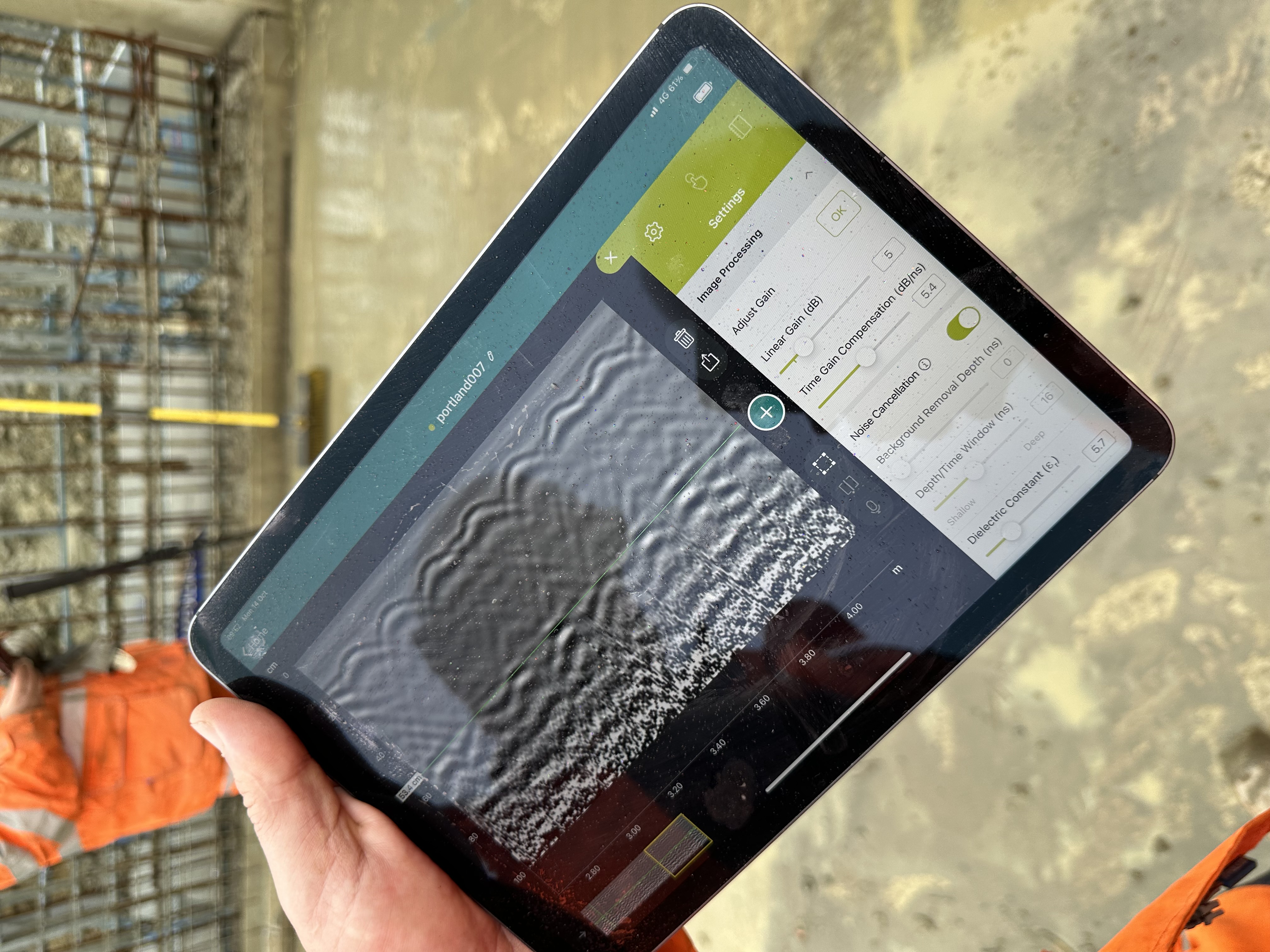
When the CAT fails, we bring in the big guns: Ground Penetrating Radar (GPR). A specialist arrives with what looks like a sophisticated lawnmower.
GPR fires radar pulses into the ground and listens for the echoes. When the radar hits a boundary between two different materials (like soil and a plastic pipe), the signal bounces back.
In theory, this is flawless. In practice, the UK is made mostly of wet clay and rubble. Wet clay absorbs radar signals like a sponge. When the specialist hands you the GPR report, it doesn't say "Gas Main Here." It gives you a sheet of squiggly black lines (hyperbolas) and a note that says: "Geophysical anomaly detected at 1.2m depth. Could be a 400kV power line. Could be half a brick. Dig carefully."
The Ultimate Detector: The Shovel
Because the drawings are fiction, the CAT is blind to plastic, and the GPR is essentially geophysics-based astrology, we are left with the final tier of the HSG47 (Avoiding Danger from Underground Services) hierarchy: Safe Digging Practice.
You bring in a 20-tonne excavator. The driver, Nige, operates this massive hydraulic beast with the delicacy of a neurosurgeon. He peels the earth away 100mm at a time.
Suddenly, there is a sound. It is a very specific, hollow scrape of steel bucket against plastic.
The entire site freezes. Time stops. You, the Site Engineer, leap into the trench with a hand shovel. Your heart is pounding. You drop to your knees in the mud and frantically start brushing the dirt away with your gloved hands, praying to every known engineering god.
You are looking for the colour.
If it is Green, it is Telecoms. You will be annoyed, because fixing fibre optics is expensive, but nobody dies.
If it is Yellow, it is Gas. You stop breathing, back away slowly, and call the network operator.
But if you wipe the mud away and see Red...
Red is High Voltage. 11kV or 33kV of raw, unforgiving electricity. You realise you were two inches of steel away from turning the bucket into a molten fireball.
You climb out of the trench, your knees shaking slightly. You look at the pristine CAD drawing in your hand that explicitly states there is absolutely nothing in this area. You throw it in the skip, tell Nige to go get a cup of tea, and start writing the Near Miss report.
We build the future. But until we invent actual X-ray vision, our greatest technological advancement is still just a bloke in a trench, wiping mud off a plastic pipe with his bare hands.
Mosbah