Soil Stabilisation: The Geotechnical Alchemy of Quicklime
There is a moment on every major British earthworks project where hope goes to die.
You have spent weeks stripping the topsoil. The excavators have dug down to the formation level for your brand-new highway. According to the geotechnical report - a beautifully bound document written in a dry office by a man who has never been rained on - you should now be standing on stiff, over-consolidated London Clay with a California Bearing Ratio (CBR) of 15%.
The reality is that it rained on Tuesday, and you are now standing knee-deep in a four-acre expanse of brown, gelatinous soup. It has the structural integrity of a chocolate pudding. If you put a 30-tonne articulated dump truck on it, the truck will simply sink to its axles and remain there as a permanent monument to your failure.
You cannot build a road on soup. You need to import thousands of tonnes of expensive crushed stone to bridge it, which will bankrupt the project.
Unless, of course, you use magic.
Welcome to the dark, incredibly violent, and highly effective world of Soil Stabilisation. We cannot change the weather, but we can change the molecular structure of the earth using brute force, heavy machinery, and an angry chemical called Quicklime.
The Science of the Soup
To understand the magic, you must understand the enemy: Clay.
Clay is a nightmare material because of its microscopic structure. It is made of tiny, flat platelets that stack on top of each other. When water gets between these platelets, it acts as a lubricant. The clay swells, loses all shear strength, and turns into the slippery, tyre-spinning muck that currently covers your site.
To fix this, we bring in Quicklime (Calcium Oxide). Quicklime is not a passive material. It is a highly reactive, incredibly thirsty, and aggressively alkaline powder. When you mix it into wet clay, it initiates a three-stage geotechnical war:
1. The Exothermic Dehydration
The moment the Quicklime touches the water in the clay, it violently hydrates to form Calcium Hydroxide. This chemical reaction is aggressively exothermic. It generates massive amounts of heat—often pushing the soil temperature well above 100°C. You are literally boiling the excess water out of the mud.
2. The Cation Exchange (The Flocculation)
This is where the true alchemy happens. The calcium ions in the lime swap places with the sodium and water molecules on the surface of the clay platelets. This strips away the "lubricant" and forces the microscopic flat sheets of clay to clump together into hard, granular blocks. Within hours, the sticky soup magically transforms into a friable, workable soil.
3. The Pozzolanic Reaction
Over the next few weeks, the high pH environment causes the silica and alumina in the clay to dissolve and react with the calcium. It forms cementitious gels. You have successfully tricked a field of wet mud into slowly turning itself into low-grade concrete.
The Military-Grade Combine Harvester
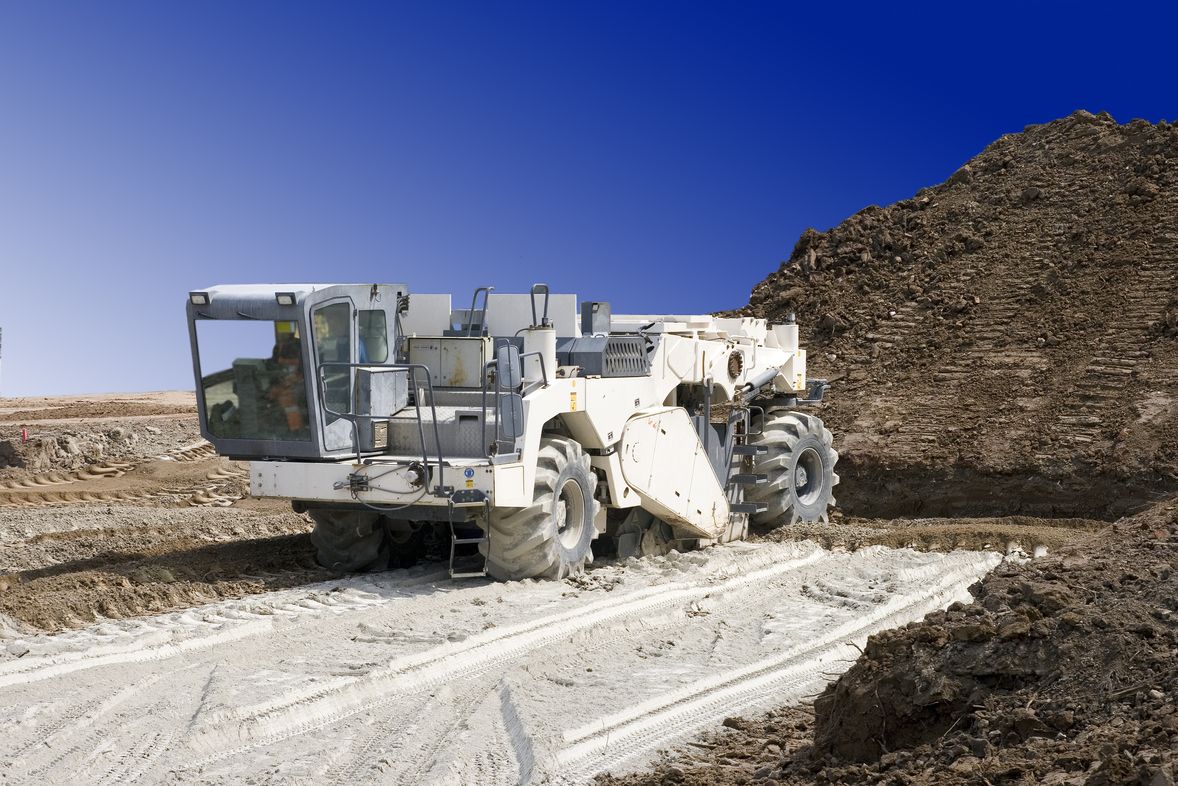
Of course, you cannot just sprinkle Quicklime onto a field with a watering can. You need the Wirtgen.
A Wirtgen Soil Stabiliser is a machine that looks like a combine harvester designed by the military for a post-apocalyptic wasteland.
First, a tractor tows a massive spreader unit across the mud, dumping a thick blanket of blindingly white Quicklime powder over the site. Then, the Wirtgen arrives. It features a massive, 2.5-metre-wide spinning steel milling drum studded with carbide teeth. It drives over the powder, violently chewing up the earth to a depth of 400mm, perfectly blending the lime and the wet clay together.
As it works, the exothermic reaction kicks in. The ground starts to literally steam. You are standing in a misty, white-out landscape of boiling earth, watching a 30-tonne machine churn through the mud. It is one of the most awe-inspiring sights in civil engineering.
The Range Rover Incident
However, there is a catch. Quicklime is incredibly light, and it is highly corrosive.
Because it is an aggressive alkali, if it gets on your sweaty skin, it burns. If you breathe it in, it is a disaster. Therefore, the entire operation is entirely at the mercy of the wind.
This brings us to the greatest hazard of soil stabilisation: The Project Director’s Car.
Directors love to visit sites when the big machinery is running. They will inevitably park their pristine, brand-new, leased black Range Rover on the edge of the haul road, step out in their spotless PPE, and watch the Wirtgen do its work.
As a Site Engineer, you will watch the windsock. You will pray to the engineering gods. But the wind in the UK is vindictive. It will suddenly gust, pick up a massive cloud of airborne Quicklime, and drift it perfectly across the site, directly over the Range Rover.
The Director will emerge from the site cabin an hour later to find his £80,000 status symbol coated in a thick layer of white dust.
At this point, you must not let them turn the windscreen wipers on. You must not let them wash it with water. Remember Step 1? Quicklime plus water equals a boiling, highly alkaline cement. If it rains, or if they try to wash it, that dust will violently react and permanently etch itself into the clear-coat paintwork, ruining the car forever.
We possess the geotechnical brilliance to alter the molecular structure of the earth and turn swamps into superhighways. But our greatest operational challenge will always be trying to explain to a furious Director why their Range Rover now looks like it has been dipped in icing sugar.
Mosbah